

In modern manufacturing and quality assurance, accurate measurement is essential for confirming that parts meet required specifications. Laser Coordinate Measuring Machines, or Laser CMMs, are 3D scanning CMM systems that combine coordinate measurement with non-contact scanning. They are used for dimensional inspection, CAD comparison, and reverse engineering, especially when parts have complex shapes or surface features that are difficult to capture with point-by-point measurement.
As manufacturers look for faster and more detailed inspection methods, Laser CMMs offer a useful combination of non-contact measurement, high-resolution data capture, and flexible application. They are used in industries such as aerospace, automotive, and heavy machinery, where large parts, complex geometries, and tight quality requirements are common.
This page explains the basic principles of Laser CMMs, their advantages, how they differ from traditional measurement methods, common use cases, and product comparisons from manufacturers such as KEYENCE, Creaform, Kreon, and Scantech.
A Laser CMM, or 3D scanning CMM, is a metrology system that uses laser triangulation, structured light, or similar optical technology to perform non-contact measurement. Unlike traditional CMMs that use a tactile probe to collect individual points, Laser CMMs scan the surface of a part and generate a point cloud: a dense set of data points representing the part’s geometry.
This point cloud can then be processed into a 3D mesh for inspection, CAD comparison, or reverse engineering. Because scanning captures large amounts of surface data quickly, Laser CMMs are useful for verifying dimensions, profiles, and surface characteristics more efficiently than conventional point-by-point measurement.
Laser CMMs typically consist of a scanning head, tracking system, and measurement software. Some models are portable, allowing users to measure parts directly on the shop floor without moving large, heavy, or delicate workpieces.
Laser CMM systems can be grouped by how the laser scanner is mounted, tracked, and used in the measurement workflow. Understanding these types helps clarify where a laser scanning CMM fits between a traditional bridge CMM, a portable arm system, and a standalone 3D scanner.
| Type | Accuracy / Range | Portability / Cost | Best Use |
|---|---|---|---|
| Stationary CMM with scanning probe | Very high accuracy; limited to the CMM’s measurement volume. | Low portability; high price range. | Precision inspection in temperature-controlled labs. |
| Arm-based CMM with laser scanner | High accuracy; measurement range depends on arm length. | Medium portability; medium to high price range. | Shop-floor inspection, part alignment, and reverse engineering. |
| Handheld or optically tracked laser scanner | Medium to high accuracy; supports small parts to wide-area measurement. | High portability; medium to high price range. | Large parts, complex surfaces, and on-site measurement. |
| Robot-mounted or automated laser CMM | High accuracy; measurement range depends on the automated line setup. | Low portability after installation; very high price range. | Automated production-line inspection. |
A stationary CMM with a laser scanning probe, such as a system equipped with a Hexagon or Renishaw-style probe head, can provide excellent accuracy but usually requires a dedicated measurement room and controlled temperature conditions. Arm-based CMM laser scanner systems, such as articulated arms with laser line probes, offer a practical balance of reach, accuracy, and mobility.
Handheld and optically tracked systems, including Creaform MetraSCAN, HandySCAN, and KEYENCE WM Series laser scanning probes, place greater emphasis on portability and speed. The KEYENCE WM Series is suited to large workpieces because it combines wireless handheld probing, laser scanning, and wide-area optical tracking in one system. Robot-mounted laser CMM systems are best suited for automated inspection lines, but they require higher upfront investment and integration planning.
Choosing between CMM measurement and 3D scanning depends on the required tolerance, part geometry, inspection speed, and how the data will be used.
Laser CMMs are used when manufacturers need to capture complex geometry quickly without relying only on point-by-point contact measurement. Because a laser scanning CMM can digitize freeform surfaces, large assemblies, and delicate parts, it supports quality inspection, CAD comparison, and reverse engineering across many industries.
In aerospace manufacturing, Laser CMMs are used to inspect turbine blades, curved aircraft panels, and large structural assemblies. Non-contact scanning captures aerodynamic surfaces efficiently, while wide-area systems support alignment checks on large parts that are difficult to move into a measurement room.
Automotive teams use CMM laser scanner systems for press die wear inspection, body-in-white gap and flush checks, and prototype shape verification. Fast point cloud acquisition makes it easier to compare actual parts with CAD data during development and production troubleshooting.
For welded frames, cabins, large castings, and construction equipment, portability is often as important as accuracy. Systems such as the KEYENCE WM Series can measure large targets on the shop floor or at the installation site, reducing the need to transport heavy workpieces.
Laser CMMs can be used to inspect implants, custom prosthetics, and other parts with organic or freeform surfaces. Non-contact measurement is especially useful when the part geometry is complex or when reverse engineering is needed for patient-specific designs.
In mold and tooling applications, laser scanning can quantify tool wear, compare surfaces before and after repair, and verify complex cavity shapes. This makes a 3D scanning CMM useful for maintenance planning as well as final dimensional inspection.
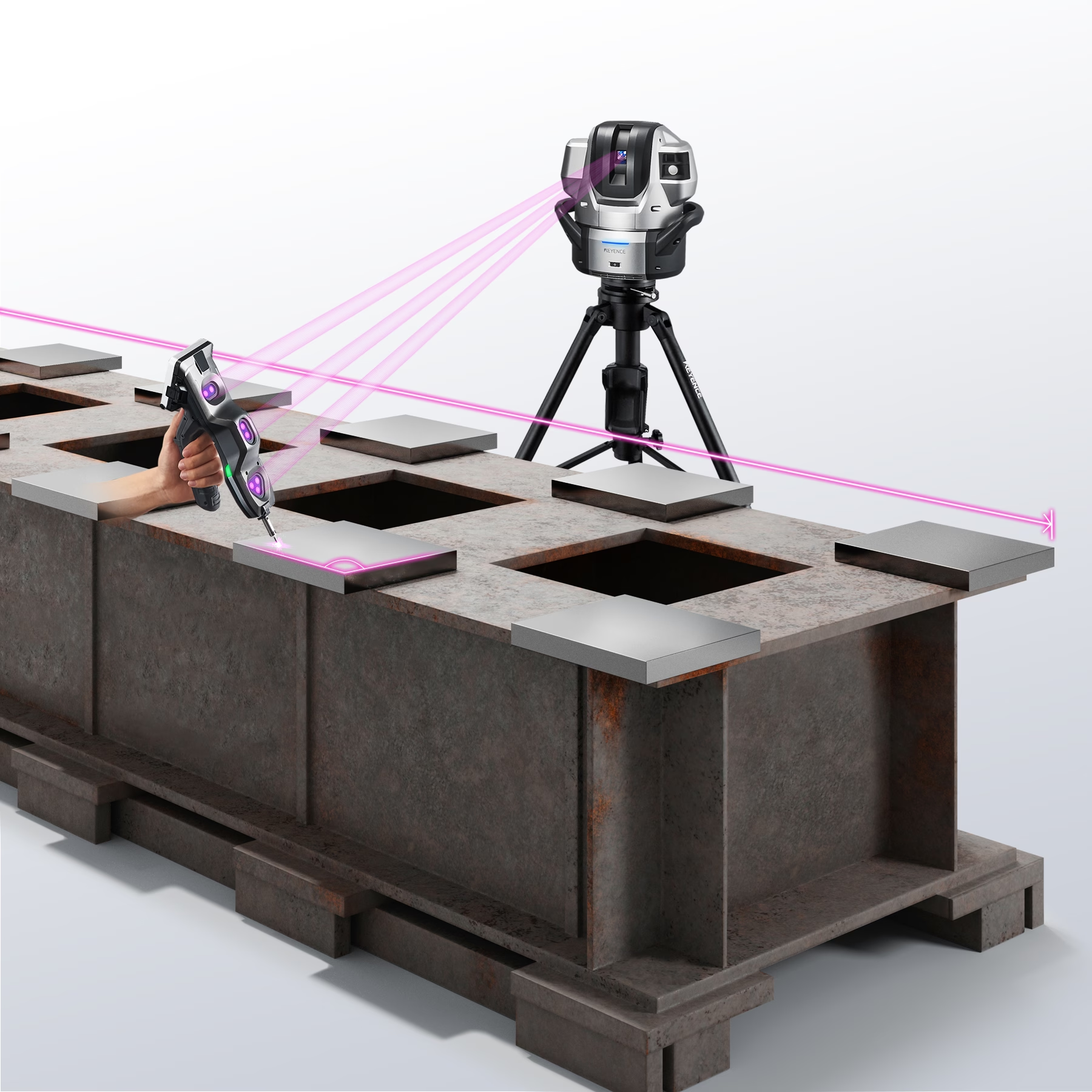
The KEYENCE WM Series is a hybrid wide-area coordinate measuring system that combines contact probing with non-contact laser scanning. It is designed for fast, flexible 3D measurement of medium to large parts directly on the shop floor.
With a measurement range of up to 25 m and 30 multi-line violet lasers, the WM Series can digitize complex shapes and freeform surfaces on large workpieces. Its portable design, fast setup, and real-time guidance help users perform dimensional inspection, shape measurement, alignment checks, and assembly verification without moving large parts to a dedicated measurement room.
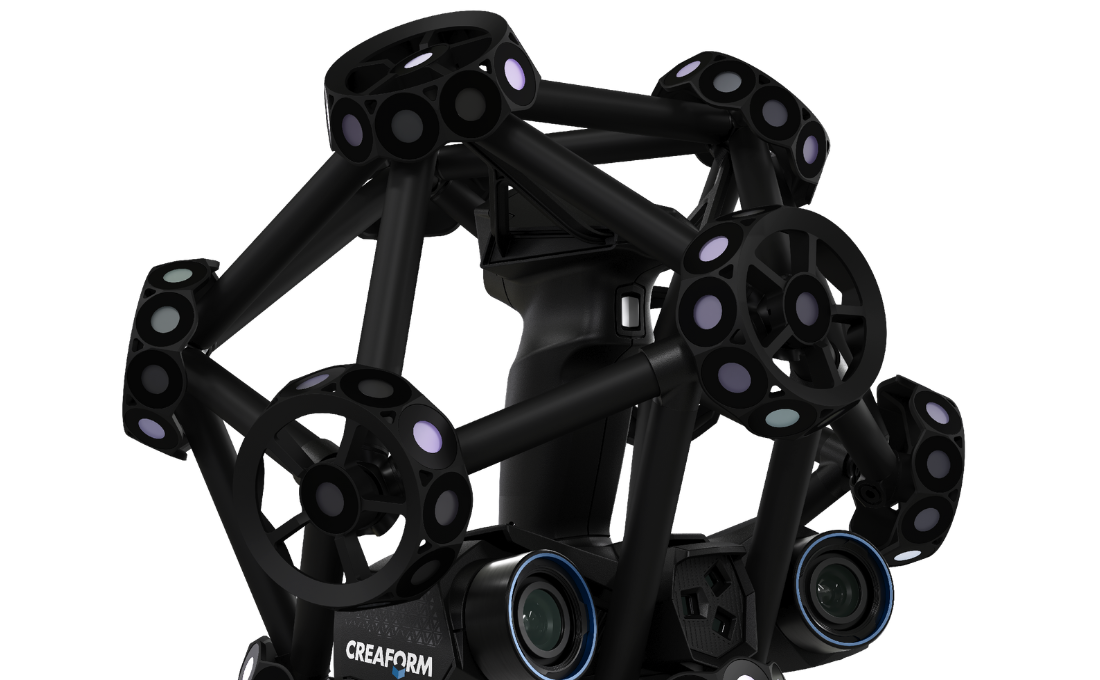
The Creaform MetraSCAN 3D is an optical laser scanning CMM designed for high-accuracy measurement in shop-floor environments. Using blue laser technology and optical tracking, it can deliver stable results even in conditions with vibration or temperature variation.
Designed for large-scale inspection and reverse engineering, MetraSCAN 3D enables fast acquisition of dense point clouds while maintaining traceable accuracy. It is commonly used in aerospace, automotive, and heavy manufacturing applications.
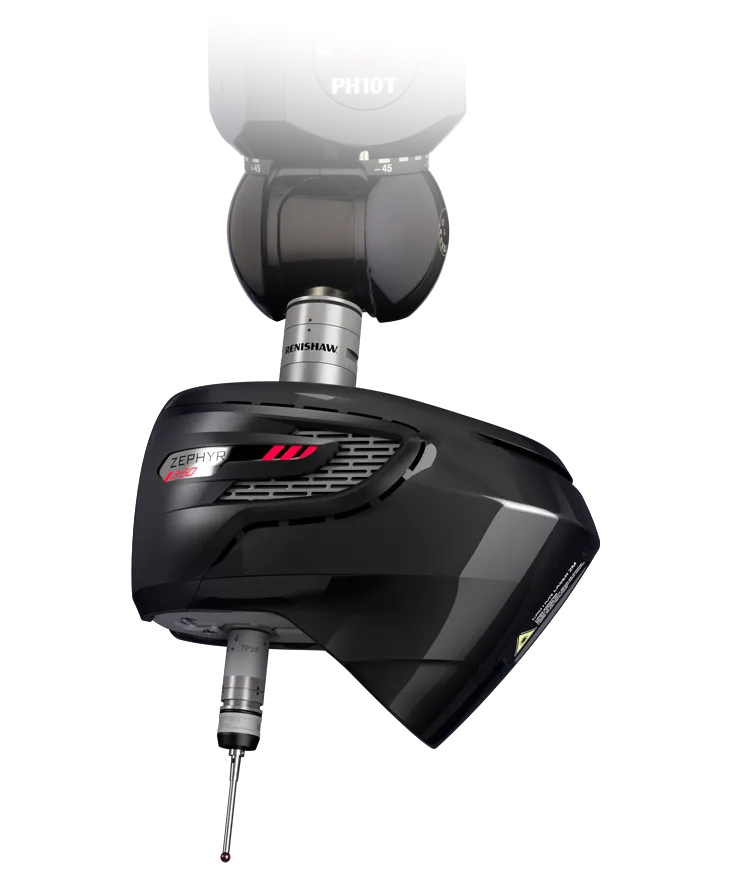
The Kreon Zephyr Series consists of high-precision laser scanning sensors designed for use with articulated arms or CMMs. These scanners use blue laser lines to capture fine surface details, including reflective and complex geometries.
Used for inspection and reverse engineering, the Zephyr Series offers a balance of scanning speed and measurement accuracy for demanding quality control applications across manufacturing sectors.
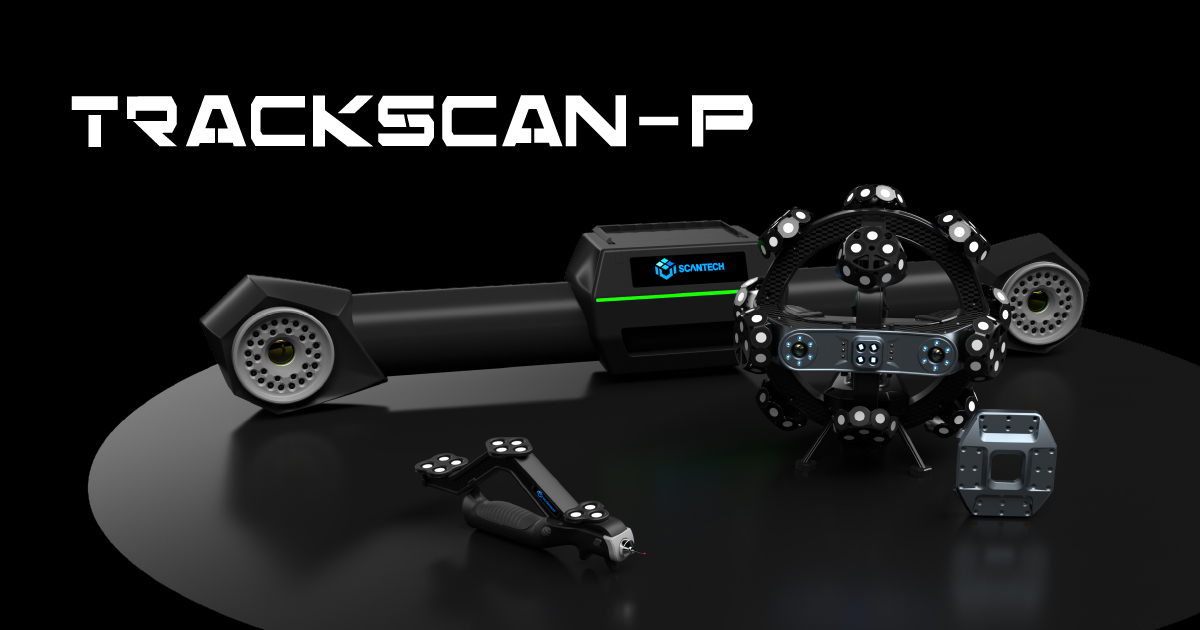
The Scantech TrackScan-P Series is an optical 3D scanning CMM that uses multiple blue laser crosses for fast, high-accuracy measurement. It can capture surface details, deep holes, and complex geometries without reflective targets, making it suitable for large assemblies and freeform surfaces.
With up to 1.9 million measurements per second and advanced tracking technology, the TrackScan-P Series supports efficient precision scanning for manufacturing, aerospace, automotive, and tooling inspection applications.
The FARO Quantum X Series is a range of portable articulated arm CMMs that support both tactile probing and laser line scanning. This hybrid approach allows users to switch between contact and non-contact measurement based on inspection requirements.
With multiple arm sizes and performance levels, the Quantum X Series is used for dimensional inspection, part alignment, and surface scanning in manufacturing and quality control applications.
The Hexagon Absolute Arm is a portable articulated arm CMM that can be used with advanced laser scanning sensors for both contact and non-contact measurement. Its ergonomic design and absolute encoder technology support reliable accuracy without time-consuming homing procedures.
When combined with laser scanners such as the RS5, the Absolute Arm provides fast surface digitization for inspection, reverse engineering, and quality assurance across a wide range of industries.
The right laser CMM depends on what you need to measure, where the measurement will take place, and whether you already own inspection equipment. If dimensional inspection is the main goal, a hybrid system that supports both contact probing and laser scanning is often a practical choice. If reverse engineering is the primary goal, a dedicated 3D scanner may be sufficient.
Workpiece size is another key factor. For parts under about 3 m, an arm-based CMM laser scanner or compact handheld system can be practical. For larger targets from 3 m to 25 m, an optically tracked handheld system or laser-tracker-style solution is usually more efficient. The KEYENCE XM Series is designed for small to medium-size workpieces up to 2 m, while the KEYENCE WM Series supports wide-area measurement up to 25 m.
Measurement environment also matters. If you have a temperature-controlled lab and need the highest precision, adding a scanning probe to a stationary CMM may be suitable. If measurements must be performed on the shop floor, a portable laser CMM is usually a better fit because it reduces setup time and avoids moving large parts.
For more guidance, see the related pages below.
Laser CMMs, also known as 3D scanning CMMs, help manufacturers inspect complex parts and capture 3D data more efficiently. By combining fast surface data capture with practical measurement accuracy, they can support dimensional inspection, CAD comparison, reverse engineering, and product development.
Tactile CMMs remain important for very tight-tolerance inspection, but laser CMMs are useful when speed, surface detail, and flexibility are priorities. They are especially valuable for large parts, freeform surfaces, and applications where moving the workpiece to a measurement room is difficult.
Systems from manufacturers such as KEYENCE, Creaform, Kreon, and Scantech offer different balances of accuracy, speed, portability, and scanning capability. Understanding your requirements for tolerance, workpiece size, measurement environment, and data use will help narrow the right laser CMM system for your application.
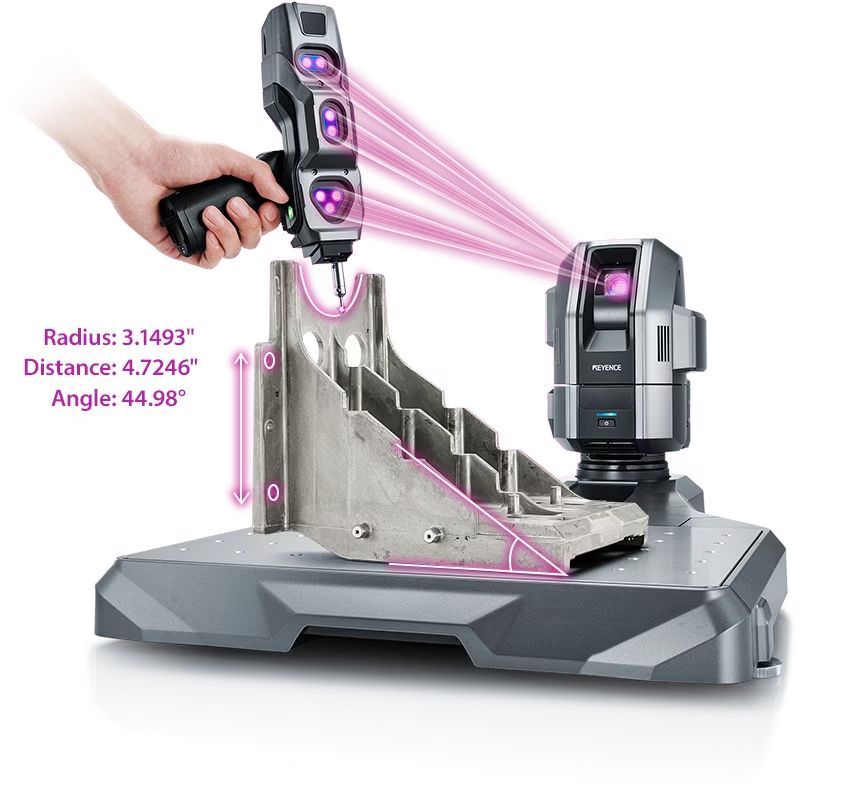
Source: KEYENCE Website(https://www.keyence.com/products/measure-sys/cmm/xm/index_pr.jsp)
This CMM has a caliper-like feel, enabling even beginners to perform high-precision measurements. It can be carried without the need for temperature control, allowing for immediate measurements at any desired location and time. As it doesn't require a large installation space, it's a CMM with a low entry barrier.
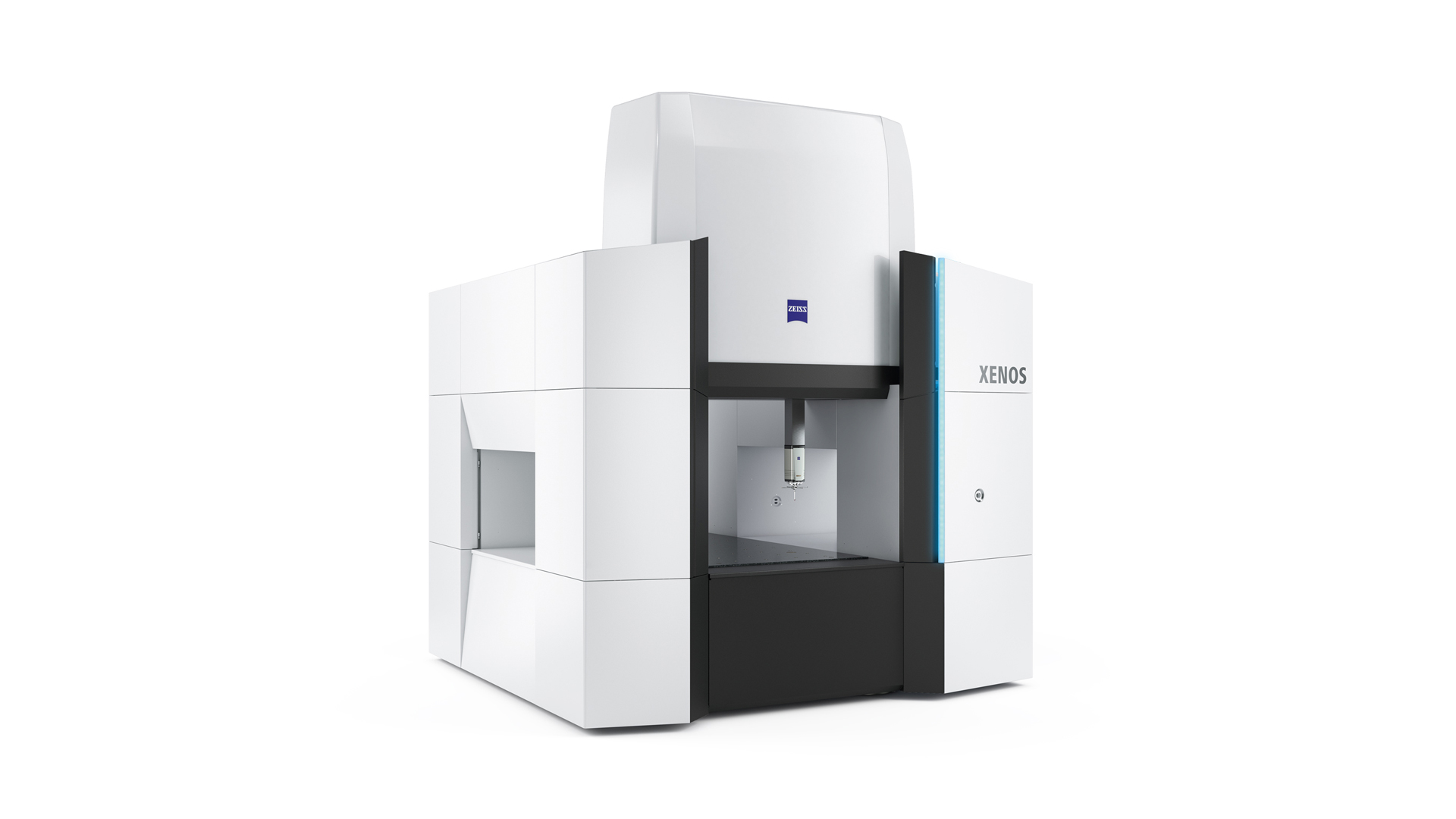
Source: Carl Zeiss Website(https://www.zeiss.com/metrology/products/systems/cmm.html)
Utilizing linear drive on all axes, this CMM boasts high precision with a maximum permissible length measurement error of 0.3+L/1000μm, repeatability of ±0.2μm, and resolution of 0.001μm. The reduced occurrence of errors allows for a decrease in the need for remeasurement.
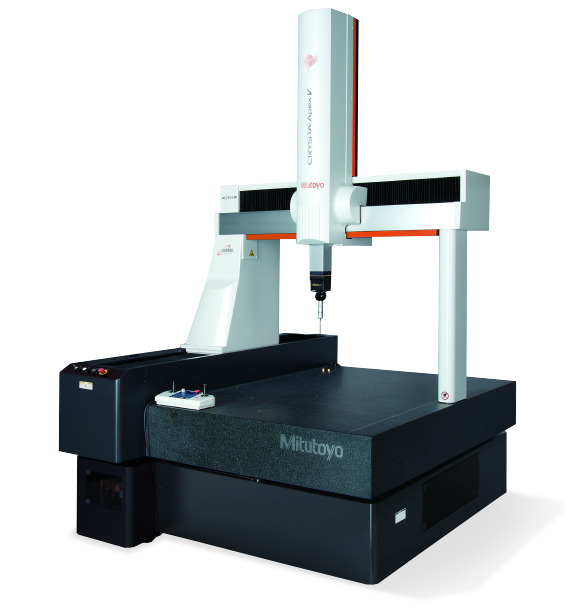
Source: Mitutoyo Website(https://www.mitutoyo.com/products/coordinate-measuring-machines/)
A CNC CMM that was first developed in 1976.
It features applications that respond to the demand for "Smart Factories" by allowing monitoring of operational status and maintenance management of the machine through the network.
Reasons for Selection