

Choosing between a coordinate measuring machine (CMM) and a laser tracker is not just about which system is more accurate. For quality control managers and production engineers, the better question is which system fits the part size, inspection environment, tolerance requirements, workflow, and budget.
A bridge CMM is often the right choice when micron-level accuracy is required and the part can be measured in a controlled room. A laser tracker is better suited to very large parts, installed equipment, and assemblies that need to be measured in place. But many factories fall somewhere between these two cases. For teams that need reliable dimensional inspection with more shop-floor flexibility, handheld and wide-area CMMs can offer a practical alternative.
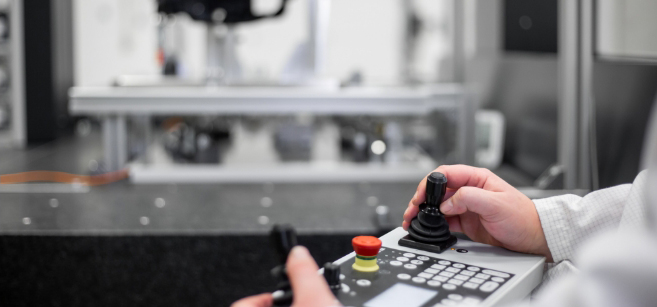
A coordinate measuring machine, or CMM, measures part geometry by collecting 3D coordinate points from the surface. In a typical bridge CMM, the probe moves along the X, Y, and Z axes over a granite base. Linear scales track the probe position, allowing the machine to calculate dimensions and GD&T characteristics such as distances, diameters, flatness, and perpendicularity.
A laser tracker measures 3D coordinates in a different way. It sends a laser beam to a retroreflective target, often called an SMR, and calculates the target position using distance and angular data. Because the system is typically mounted on a tripod and can cover a large measurement volume, it is often used for aircraft structures, large machine tools, shipbuilding components, and other parts that are difficult to move into a lab.
In simple terms, a bridge CMM is built for controlled, high-accuracy inspection, while a laser tracker is built for large-scale measurement in open spaces. A wide-area CMM such as the KEYENCE WM Series sits between these categories by combining portable operation with dimensional and shape measurement for large parts.
| Comparison Point | Bridge CMM | Laser Tracker | KEYENCE WM Series |
|---|---|---|---|
| Accuracy | ±1–2 µm | ±15 µm + 6 µm/m | ±(28 + 5L/1000) µm |
| Measurement Range | Approx. 2–3 m | 30 m+ | Up to 25 m |
| Portability | Fixed; lab use only | Tripod-mounted | Portable and wireless |
| Setup Time | Requires a climate-controlled room | 15–30 min | Approx. 5 min |
| Price Range | $80,000–$300,000+ | $100,000–$250,000+ | Contact manufacturer |
If accuracy is the top priority, a bridge CMM is usually the preferred option. High-end stationary CMMs can measure in the low-micron range, making them suitable for aerospace components, medical devices, precision machined parts, and other strict-tolerance applications. Their accuracy comes from a rigid structure, controlled machine motion, calibrated probing systems, and stable measurement conditions.
Laser trackers are also highly accurate, but their performance depends more heavily on distance, angle, target handling, and environmental conditions. They are designed for large measurement volumes, so they often trade some fine-scale accuracy for reach and flexibility. For large assemblies, that trade-off is usually acceptable. For very tight-tolerance inspection on small or medium-size parts, a bridge CMM is often the better fit.
The key is to match the system to the inspection task. Choose a bridge CMM when accuracy comes first and the part fits within the machine envelope. If the part is too large, too heavy, or too disruptive to move, a portable system such as the KEYENCE WM Series may provide a more practical balance of accuracy and shop-floor accessibility.
Measurement volume is where laser trackers have a clear advantage. A laser tracker can measure large structures across tens of meters, making it useful for aircraft fuselage assembly, large molds, heavy equipment, shipbuilding, construction components, and machine alignment. In these cases, moving the part to a CMM room may be impossible, unsafe, or too time-consuming.
A bridge CMM is limited by its physical measuring envelope. Even when a large bridge CMM is available, the workpiece must be lifted, transported, fixtured, stabilized, and measured within the machine’s travel range. For very large or installed parts, that process can create more downtime than the inspection itself.
However, not every large-part application requires the scale or complexity of a laser tracker. Many manufacturers need more range than a stationary CMM can provide, but not a system designed for extremely large assembly spaces. The KEYENCE WM Series addresses this middle ground with a measurement range of up to 25 m, making it a practical option for large workpieces that need on-site dimensional inspection without the complexity of a conventional laser tracker.
Portability changes the inspection workflow. A stationary CMM generally requires a dedicated measurement room with temperature control, stable flooring, and trained operators. This can deliver excellent measurement performance, but it also pulls parts away from production. For large parts, heavy parts, or in-process inspection, that movement can create delays and unnecessary handling risk.
Laser trackers are portable because they can be mounted on a tripod and brought to the workpiece. Still, they require careful setup, stable positioning, target handling, and a clear line of sight between the tracker and the retroreflector. If the measurement path is blocked by the part, fixture, machine structure, or surrounding equipment, the operator may need to reposition the tracker or adjust the inspection plan.
A wide-area CMM such as the KEYENCE WM Series is designed for easier on-site measurement. The system can be carried to the work area, set up quickly, and used with a wireless handheld probe, reducing cable routing issues around large parts. Because the operator can move around the workpiece and measure directly with the probe, it is well suited to inspections where the part is too large or inconvenient to bring to a lab.
Bridge CMMs and laser trackers are both major capital investments. A bridge CMM can range from tens of thousands of dollars to several hundred thousand dollars, depending on measuring volume, accuracy, probing configuration, software, and installation requirements. Laser trackers can also be costly once accessories, software, SMR targets, training, and calibration are included.
Purchase price is only one part of the decision. A bridge CMM may also require a climate-controlled room, controlled foundations, annual calibration, maintenance, fixturing, and trained operators. A laser tracker may reduce the need to move large parts, but it can add costs related to specialized software, targets, operator training, setup time, and periodic calibration.
For this reason, the best system is not always the one with the highest specification. It is the one that meets tolerance requirements while reducing the total cost of inspection. KEYENCE does not publicly list standard pricing for the XM or WM Series, so manufacturers should contact the company for a quotation. Because these systems are designed for shop-floor use without a dedicated metrology room, they may help reduce facility costs, part transport time, and reliance on specialized measurement labor.
The choice between a CMM and a laser tracker often becomes difficult when neither option fits the actual production environment. A bridge CMM offers excellent accuracy, but the workpiece must fit the measuring volume and be brought into a controlled room. For large parts, this can mean crane handling, production downtime, and repeated movement between manufacturing and inspection areas.
A laser tracker solves the size problem, but it may be more complex than necessary for many factories. It can require experienced operators, careful setup, line-of-sight planning, and a larger budget. For manufacturers that need reliable dimensional inspection of large parts on the shop floor, a conventional laser tracker may be more system than the job requires.
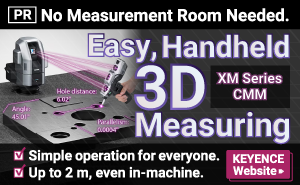
This is where handheld and wide-area CMMs become a practical third option. The KEYENCE XM Series is suitable for small to medium-size workpieces, with handheld probing and a measurement range of up to 2 m. The KEYENCE WM Series is designed for larger workpieces, offering a measurement range of up to 25 m and support for both contact probing and laser scanning.
With wireless probe operation, CAD data comparison, and the ability to measure outside a dedicated temperature-controlled lab, these systems help bring dimensional inspection closer to production.
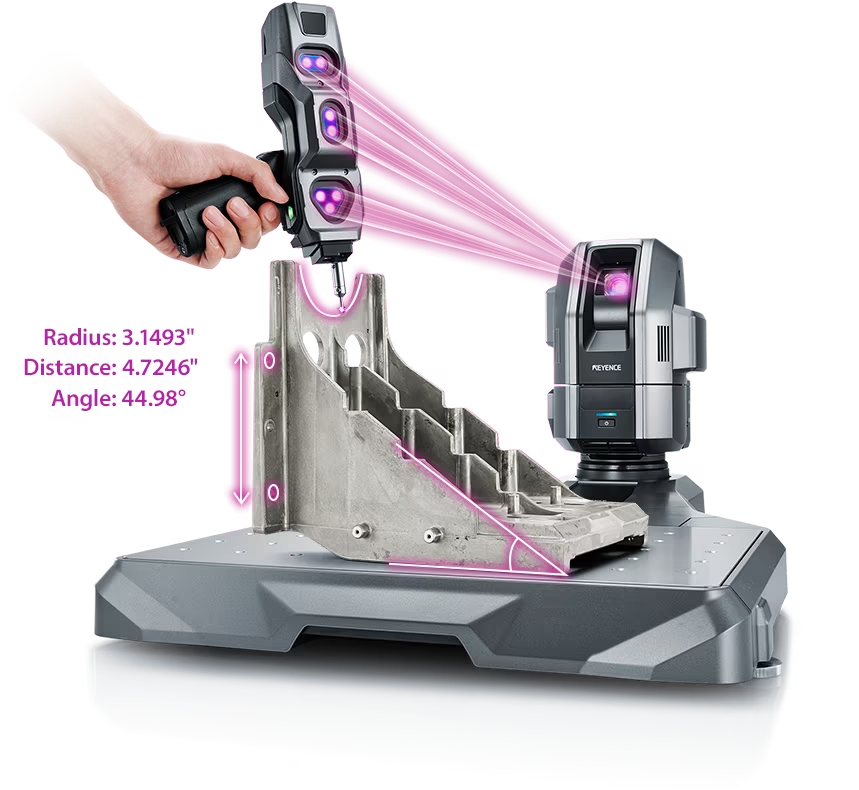
Source: KEYENCE Website(https://www.keyence.com/products/measure-sys/cmm/xm/index_pr.jsp)
This CMM has a caliper-like feel, enabling even beginners to perform high-precision measurements. It can be carried without the need for temperature control, allowing for immediate measurements at any desired location and time. As it doesn't require a large installation space, it's a CMM with a low entry barrier.
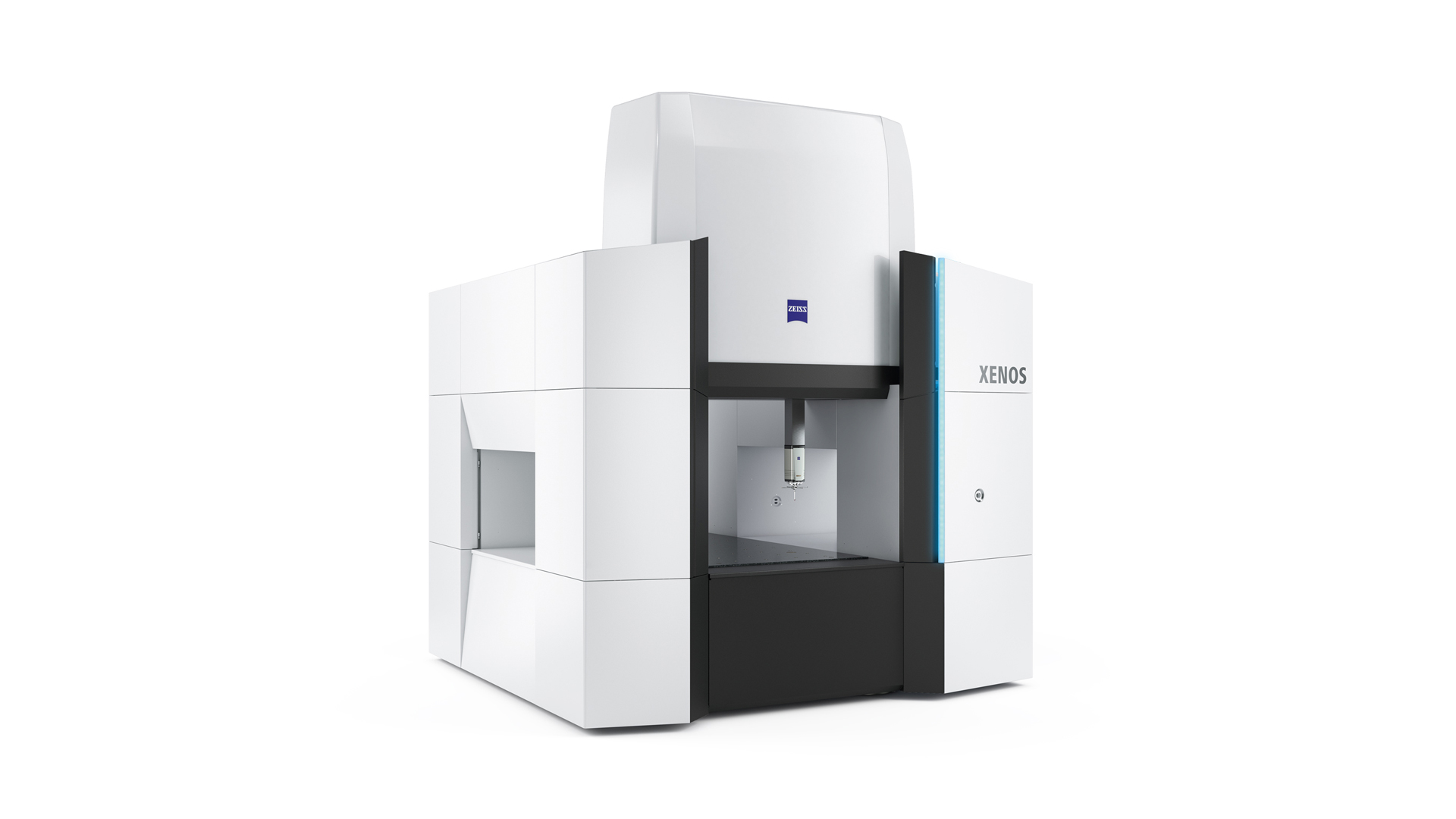
Source: Carl Zeiss Website(https://www.zeiss.com/metrology/products/systems/cmm.html)
Utilizing linear drive on all axes, this CMM boasts high precision with a maximum permissible length measurement error of 0.3+L/1000μm, repeatability of ±0.2μm, and resolution of 0.001μm. The reduced occurrence of errors allows for a decrease in the need for remeasurement.
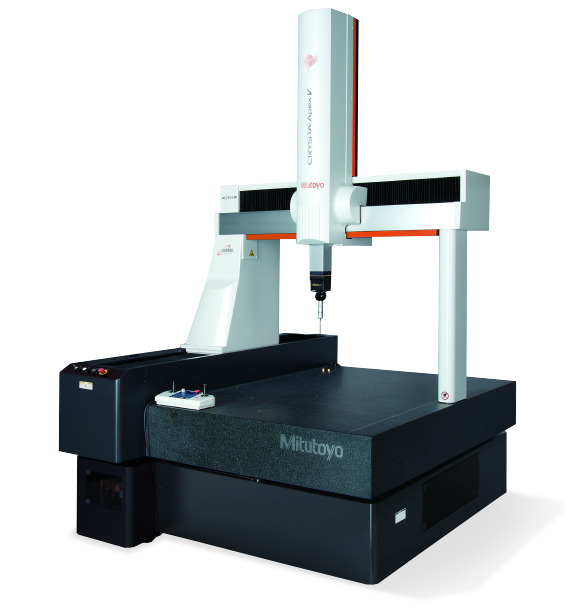
Source: Mitutoyo Website(https://www.mitutoyo.com/products/coordinate-measuring-machines/)
A CNC CMM that was first developed in 1976.
It features applications that respond to the demand for "Smart Factories" by allowing monitoring of operational status and maintenance management of the machine through the network.
Reasons for Selection